Showing posts with label Spain. Show all posts

Wednesday, 31 July 2024

Paseo del Prado and Buen Retiro, a landscape of Arts and Sciences,Spain.


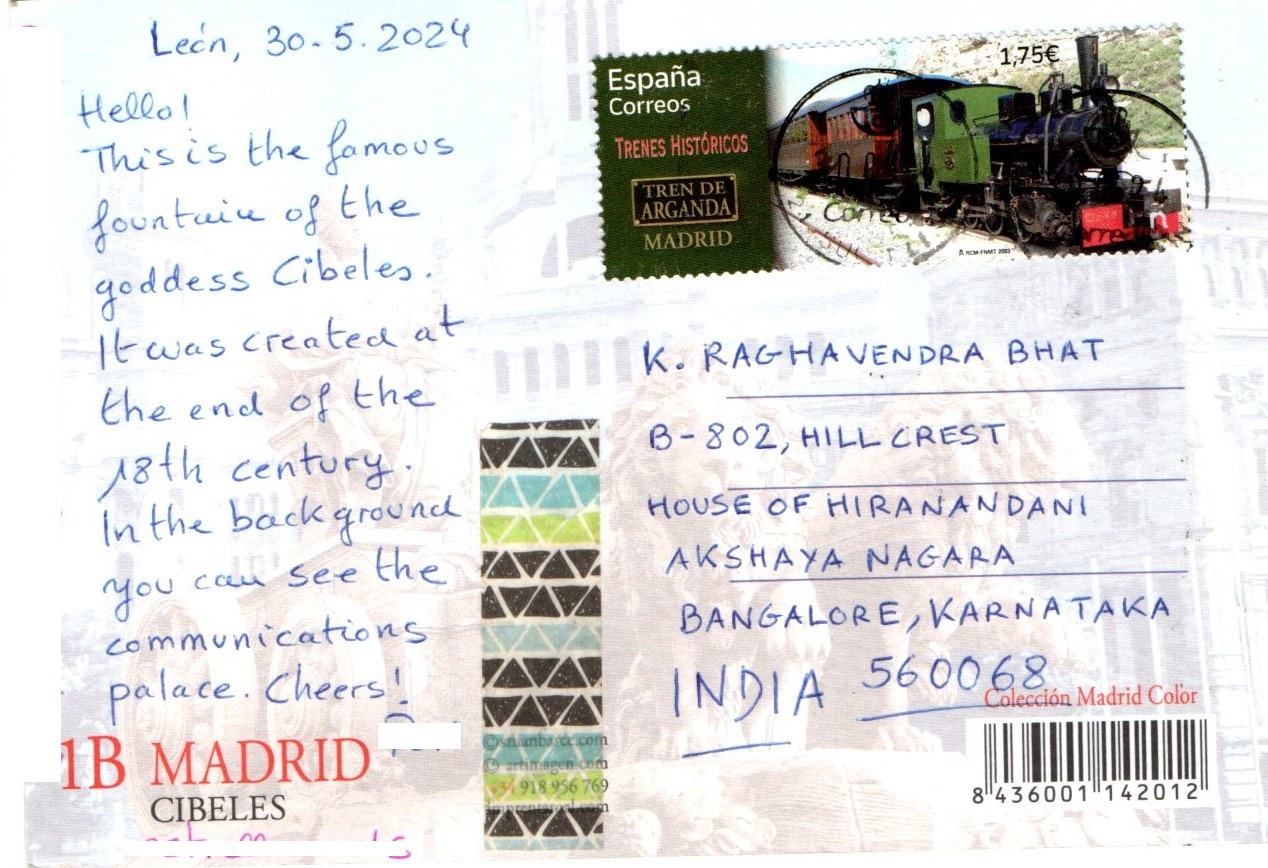
Located at the urban heart of Madrid, this cultural landscape evolved since the creation of the tree-lined Paseo del Prado avenue, a prototype of the Hispanic alameda, in the 16th century. The avenue features major fountains, notably the Fuente de Apolo and the Fuente de Neptuno, and the Fuente de Cibeles, an iconic symbol of the city, surrounded by prestigious buildings. The site embodies a new idea of urban space and development from the enlightened absolutist period of the 18th century.

Thank you Puri for the exquisite heritage site card of your country and historic stamp on Train.

Spain

Date of Inscription: 2021

Minor boundary modification inscribed year: 2023

Dossier: 1618bis

Friday, 23 December 2022

Risco Caido and the Sacred Mountains of Gran Canaria Cultural Landscape,Spain.

Located in a vast mountainous area in the centre of Gran Canaria, Risco Caído comprises cliffs, ravines and volcanic formations in a landscape of rich biodiversity. The landscape includes a large number of troglodyte settlements — habitats, granaries and cisterns — whose age is proof of the presence of a pre-Hispanic culture on the island, which has evolved in isolation, from the arrival of North African Berbers, around the beginning of our era, until the first Spanish settlers in the 15th century. The troglodyte complex also includes cult cavities and two sacred temples, — Risco Caído and Roque Bentayga — where seasonal ceremonies were held. These temples are thought to be linked to a possible cult of the stars and Mother Earth.
Spain
Date of Inscription: 2019
Dossier: 1578
Source:Unesco.Org
Thank you Adolfo for the beautiful heritage site card with nice postal cancellation on Gandhi stamp. 

Saturday, 29 October 2022

Postcard from Spain.


Than you #Marina.


Thank you Jose for the nice Unesco postcard and beautiful stamp on the envelope and many stamps inside the envelope also.

Monday, 12 September 2022

Rock Art of the Mediterranean Basin on the Iberian Peninsula, Spain.

The prehistoric rock-art sites  form an exceptionally large group. Here the way of life during a critical phase of human development is vividly and graphically depicted in paintings whose style and subject matter are unique. It is largest group of rock-art sites anywhere in Europe,
providing an exceptional picture of human life in a critical phase of human development. The graphically depicted paintings  are unique in style and subject matter. Received the beautiful heritage site card with nice stamp from
Boris.

Spain-

Date of Inscription: 1998

Ref:Unesco.Org

2022 Stamp-Tourism - Gastronomy


Sunday, 17 April 2022

Pyrénées - Mont Perdu,Spain.


This outstanding mountain landscape, which spans the contemporary national borders of France and Spain, is centered around the peak of Mount Perdu, a calcareous massif that rises to 3,352 m. The site, with a total area of 30,639 ha, includes two of Europe's largest and deepest canyons on the Spanish side and three major cirque walls on the more abrupt northern slopes with France, classic presentations of these geological landforms. The site is also a pastoral landscape reflecting an agricultural way of life that was once widespread in the upland regions of Europe but now survives only in this part of the Pyrénées. Thus it provides exceptional insights into past European society through its landscape of villages, farms, fields, upland pastures and mountain roads.

Spain/France
Date of Inscription: 1997
Spain: Autonomous Community of Aragón, Province of Huesca, Communes of Torla, Fanlo, Tella-Sin, Puértolas, Bielsa, and Broto
France: Midi-Pyrénées Region, Hautes-Pyrénées Déparetment; 1999 Extension: Commune of Gèdre-TO BE COLLECTED.
Thank you Jordi for the beautiful site card affixing nice stamps, especially of Late Indira, Prime Minister of India.
2017 King Felipe VI
2015 King Felipe VI
2019 Indira Gandhi (P.M of INDIA)
.

Sunday, 19 December 2021

San Cristóbal de La Laguna, Spain.


This heritage site is located on the Island of Tenerife, part of the Autonomous Community of the Canary Islands in Spain. The property includes two original town centres each belonging to a different time of history: the so-called Upper Town is the initial founding site next to the lagoon, and has an unplanned urban structure; and the Lower Town, one kilometre to the East, which is designed on a grid. Its wide streets and open spaces have a number of fine churches and public and private buildings dating from the 16th to the 18th century.
Thank you Belen for the beautiful site card and nice odd shaped stamp.
Spain
Province of Santa Cruz de Tenerife, Canary Islands
Date of Inscription: 1999
Ref: 929
Source: Unesco.Org.

2018 Stamp-Flora -The Grandpa Tree

Friday, 20 September 2019

Renaissance Monumental Ensembles of Úbeda and Baeza,Spain.


The urban morphology of the two small cities of Úbeda and Baeza in southern Spain dates back to the Moorish 9th century and to the Reconquista in the 13th century. An important development took place in the 16th century, when the cities were subject to renovation along the lines of the emerging Renaissance. This planning intervention was part of the introduction into Spain of new humanistic ideas from Italy, which went on to have a great influence on the architecture of Latin America.
Spain
Province of Jaen, Autonomous Community of Andalusia
Date of Inscription: 2003
Ref: 522rev- Source(Unesco.Org)
Thank you Jordi for the beautiful card and nice stamp/s
2017 Stamp- EUROPA Stamps - Palaces and Castles
2015 Stamp- King Felipe VI

Tuesday, 30 October 2018

Caiphate City of Medina Azahara,Spain.


The Caliphate city of Medina Azahara is an archaeological site of a city built in the mid-10th century CE by the Umayyad dynasty as the seat of the Caliphate of Cordoba. After prospering for several years, it was laid to waste during the civil war that put an end to the Caliphate in 1009-1010. The remains of the city were forgotten for almost 1,000 years until their rediscovery in the early 20th century. This complete urban ensemble features infrastructure such as roads, bridges, water systems, buildings, decorative elements and everyday objects. It provides in-depth knowledge of the now vanished Western Islamic civilization of Al-Andalus, at the height of its splendour.
Spain
Date of Inscription: 2018
Ref: 1560(Unesco.Org)
Received this magnificent postcard with beautiful stamp was sent by Jordi.Thanks a lot.
2015 Stamp- King Felipe VI
2018 Stamp- The 25th Anniversary of the Last Travelling Post Office

Monday, 15 October 2018

Mudejar Architecture of Aragon,Spain.


The development in the 12th century of Mudejar art in Aragon resulted from the particular political, social and cultural conditions that prevailed in Spain after the Reconquest. This art, influenced by Islamic tradition, also reflects various contemporary European styles, particularly the Gothic. Present until the early 17th century, it is characterized by an extremely refined and inventive use of brick and glazed tiles in architecture, especially in the belfries.
Provinces of Teruel and Zaragoza, Autonomous Community of Aragon
Date of Inscription: 1986
Extension: 2001
Minor boundary modification inscribed year: 2016
Ref: 378ter
Source-(Unesco.Org)
Thank you Borisfor the beautiful self made card from your photo shoot and odd shaped stamp. 
2018-Stamp- - Chess "Thermochromic Ink"ie. heat sensitive

Wednesday, 13 June 2018

University and Historic Precinct of Alcalá de Henares,Spain.


Founded by Cardinal Jiménez de Cisneros in the early 16th century, Alcalá de Henares was the world's first planned university city. It was the original model for the Civitas Dei (City of God), the ideal urban community which Spanish missionaries brought to the Americas. It also served as a model for universities in Europe and elsewhere.
Date of Inscription: 1998
Ref: 876 ( unesco.org )
Thank you Belen for  this nice card and stamp.
2018 Stamp- The Roads of the North Coast

Ibiza, Biodiversity and Culture,Spain.


Ibiza provides an excellent example of the interaction between the marine and coastal ecosystems. The dense prairies of oceanic Posidonia (seagrass), an important endemic species found only in the Mediterranean basin, contain and support a diversity of marine life. Ibiza preserves considerable evidence of its long history. The archaeological sites at Sa Caleta (settlement) and Puig des Molins (necropolis) testify to the important role played by the island in the Mediterranean economy in protohistory, particularly during the Phoenician-Carthaginian period. The fortified Upper Town (Alta Vila) is an outstanding example of Renaissance military architecture; it had a profound influence on the development of fortifications in the Spanish settlements of the New World.
Date of Inscription: 1999
Ref: 417rev ( unesco.org )
Received this nice card from Belen in Spain.
2018 Stamp- The Roads of the North Coast

Monday, 7 May 2018

Old Town of Ávila with its Extra-Muros Churches,Spain.


The city of Ávila is located in the centre of Spain, in the Autonomous Community of Castile and León. Founded in the 11th century to protect the Spanish territories from the Moors, this 'City of Saints and Stones' has maintained its medieval austerity. Ávila is an outstanding example of a fortified city from the Middle Ages, the surrounding walls of which are fully intact.  This purity of form can still be seen in the Gothic cathedral and fortifications that, with their 87 semi-circular towers and nine gates, is the most complete found in Spain.Ávila alone has kept its surrounding walls, which in part  date back to 1090, while the greater part appear to have been rebuilt during the 12th century.
Date of Inscription: 1985
Minor boundary modification inscribed year: 2007
Ref: 348bis (unesco.org)
Thank you Belen for the dazzling site card with nice stamp.And,interestingly this is my 600th UNESCO heritage site card collected so far in 2 years.
2018 Stamp-Tourism

Sunday, 8 October 2017

Doñana National Park,Spain.


Doñana National Park in Andalusia occupies the right bank of the Guadalquivir river at its estuary on the Atlantic Ocean. It is notable for the great diversity of its biotopes, especially lagoons, marshlands, fixed and mobile dunes, scrub woodland and maquis. It is home to five threatened bird species. It is one of the largest heronries in the Mediterranean region and is the wintering site for more than 500,000 water fowl each year.
Thank you so much Patricia for this  radiant heritage site card.
Date of Inscription: 1994
Ref: 685bi
2016 Stamp- King Felipe VI


Friday, 16 June 2017

Garajonay National Park,Spain.


Not far off the north-west coast of Africa lies the island of La Gomera, one of the seven islands that make up the Canary Islands archipelago in the Atlantic. These high, volcanic islands are the first to receive the rains arriving from the west, and have thus retained the remnants of a rich and luxuriant forest — the laurisilva or Laurel forest — on their windward peaks, which covers 70 % of this park..
Received this nice card from Anastsia.
2017 Stamp- International Year of Sustainable Tourism for Development
2016 Stamp-King Felipe VI (Denomination:A)
Date of Inscription: 1986
Ref: 380

Saturday, 29 April 2017

Antequera Dolmens Site,Spain


This site is a serial property made up of three megalithic monuments:
Menga Dolmen,
Viera Dolmen and
Tholos of El Romeral,
(and two natural monuments, La Peña de los Enamorados and El Torcal de Antequera.)
Built during the Neolithic and the Bronze Age out of large stone blocks that form chambers and spaces with lintelled roofs (Menga and Viera) or false cupolas (El Romeral), and used for rituals and funerary purposes, the Antequera megaliths are widely recognised examples of European Megalithism. The megalithic structures are presented in the guise of the natural landscape (buried beneath earth tumuli) and their orientation is based on two natural monuments: La Peña de los Enamorados and El Torcal. These are two indisputable visual landmarks within the property.
This is the 4th card received from Belen on the same day.Thank you for the scenic card.
2016 Stamp- King Felipe VI.
Date of Inscription: 2016
Ref: 1501

Vizcaya Bridge,Spain.


Vizcaya Bridge straddles the mouth of the Ibaizabal estuary, west of Bilbao. It was designed by the Basque architect Alberto de Palacio and completed in 1893. The 45-m-high bridge with its span of 160 m, merges 19th-century iron working traditions with the then new lightweight technology for this wonderful card. of twisted steel ropes. It was the first bridge in the world to carry people and traffic on a high suspended gondola and was used as a model for many similar bridges in Europe, Africa and the America only a few of which survive. With its innovative use of lightweight twisted steel cables, it is regarded as one of the outstanding architectural iron constructions of the Industrial Revolution.
Thank you Belen for this wonderful card.
2017 stamp- International Year of Sustainable Tourism for Developmen.
Date of Inscription: 2006
Ref: 1217


Thank you Jaime for the beautiful,mega UNESCO World Heritage site card and nice stamp/s
2018 Stamp- The 90's Generation
2016 Stamp- King Felipe VI


Historic Walled Town of Cuenca,Spain.


Built by the Moors in a defensive position at the heart of the Caliphate of Cordoba, Cuenca is an unusually well-preserved medieval fortified city. Conquered by the Castilians in the 12th century, it became a royal town and bishopric endowed with important buildings, such as Spain's first Gothic cathedral, and the famous hanging houses, suspended from sheer cliffs overlooking the Huécar river. Taking full advantage of its location, the city towers above the magnificent countryside.
Received this interesting card fro Belen in Spain.n
2015 stamp-The 450th Anniversary of the City of San Agustín
Date of Inscription: 1996
Ref: 781
---------------------------

Old Town of Caceres, Spain.


The city's history of battles between Moors and Christians is reflected in its architecture, which is a blend of Roman, Islamic, Northern Gothic and Italian Renaissance styles. Of the 30 or so towers from the Muslim period, the Torre del Bujaco is the most famous.Cáceres has been a trade route city and a political centre of the local nobles for many centuries. Since prehistoric times, people from different cultures have gathered in Cáceres and have shaped its strong historical roots. Pre-Roman settlements occupied the original plot followed by the Roman, Arab, Jewish and Christian people.
Belen in Spain sent this  card with majestic view.
2017 stamp- Gabriel de Castilla Antarctic Base.
Date of Inscription: 1986
Minor modification inscribed year: 2016
Ref: 384bis

Tuesday, 27 December 2016

Historic City of Toledo,Spain.


  # Marina,

Alhambra, Generalife and Albayzín, Granada,Spain.

Received 3rd site card after 7 years.


# Jordi.

Rising above the modern lower town, the Alhambra and the Albaycín, situated on two adjacent hills, form the medieval part of Granada. To the east of the Alhambra fortress and residence are the magnificent gardens of the Generalife, the former rural residence of the emirs who ruled this part of Spain in the 13th and 14th centuries. The residential district of the Albaycín is a rich repository of Moorish vernacular architecture, into which the traditional Andalusian architecture blends harmoniously.
Date of Inscription: 1984
Ref: 314bis ( unesco.org )
Thank you Brian for the beautiful card and nice Postcrossing stamp.
2016 Stamp-Postcrossing.