Showing posts with label Lithuania. Show all posts

Wednesday, 2 November 2022

Monday, 31 October 2022

Sunday, 8 January 2017

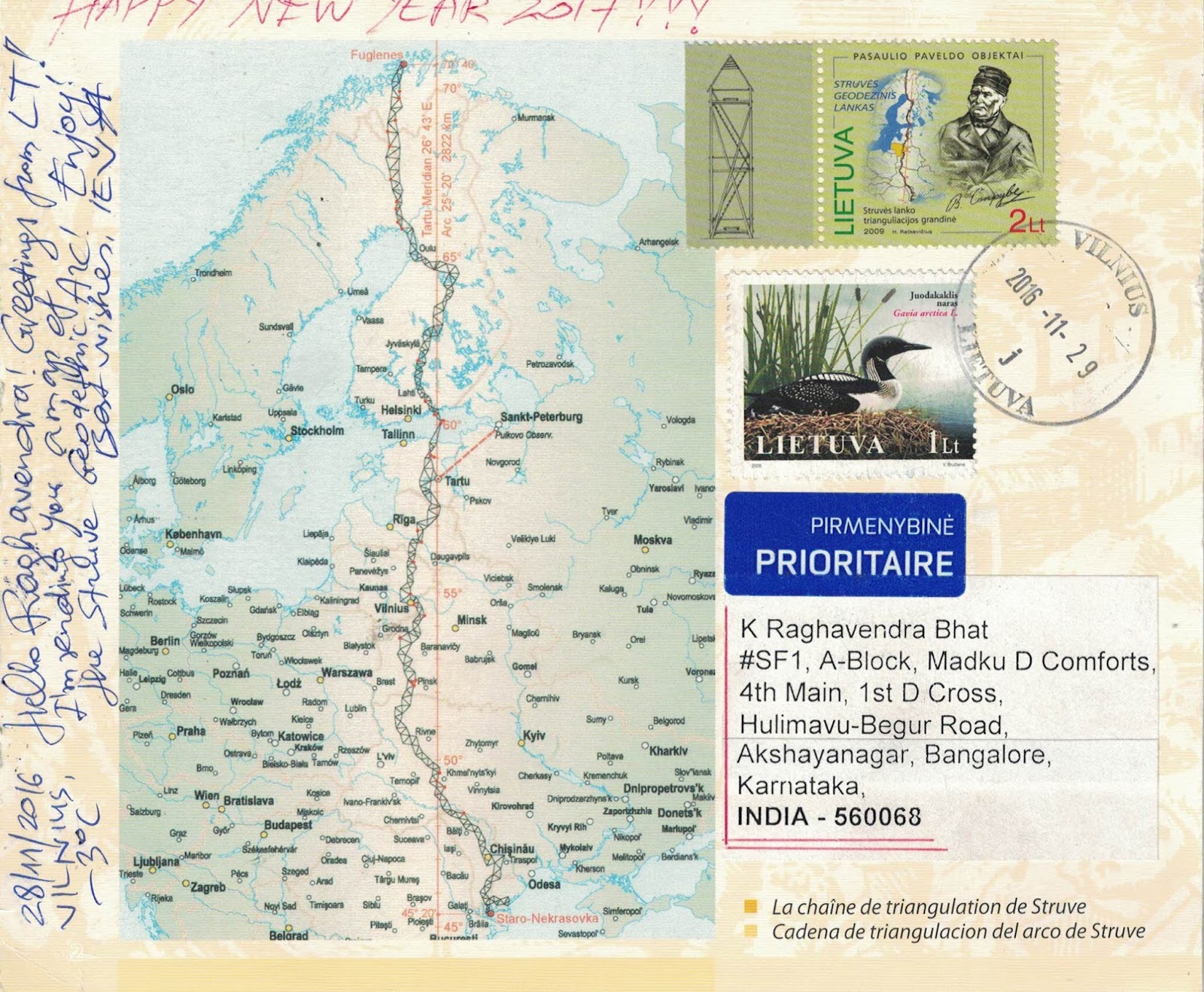
Struve Geodetic Arc,Lithuania.


It is a chain of survey triangulations stretching from Hammerfest in Norway to the Black Sea, through 10 countries and over 2,820 km. These are points of a survey, carried out between 1816 and 1855 by the astronomer Friedrich Georg Wilhelm Struve, which represented the first accurate measuring of a long segment of a meridian. This helped to establish the exact size and shape of the planet and marked an important step in the development of earth sciences and topographic mapping. It is an extraordinary example of scientific collaboration among scientists from different countries, and of collaboration between monarchs for a scientific cause.
                                   Struve Geodetic Arc Chain.
1 Norway 2 Sweden 3 Finland  4 Russia  5 Estonia 6 Latvia 7 Lithuania   8 Belarus 9 Moldova 10 Ukraine  
Date of Inscription: 2005
Ref: 1187
Extremely thankful to Eva in Lithuania for the rare card with matching stamp.

One more card received today with matching stamp.Than you Eva for the card made by you  and affixing matching stamp of 2009 and definitive stamp of year 2000.


Wednesday, 28 December 2016

Kernave Archaeological Site (Cultural Reserve of Kernave),Lithuania.


# Eva.

The KernavÄ— Archaeological site, about 35 km north-west of Vilnius in eastern Lithuania, represents an exceptional testimony to some 10 millennia of human settlements in this region. Situated in the valley of the River Neris, the site is a complex ensemble of archaeological properties, encompassing the town of KernavÄ—, forts, some unfortified settlements, burial sites and other archaeological, historical and cultural monuments from the late Palaeolithic Period to the Middle Ages. (UNESCO#1137)# Eva in Lithuania sent this card.

Tuesday, 22 November 2016

Vilnius Historic Centre,Lithuania.


The Vilnius Historic Centre began its history on the glacial hills that had been intermittently occupied from the Neolithic period; a wooden castle was built around 1000 AD to fortify Gedimino Hill, at the confluence of the Neris and Vilnia rivers. The settlement did not develop as a town until the 13th century, during the struggles of the Baltic peoples against their German invaders. By 1323, when the first written reference to Vilnia occured, it was the capital of the Grand Duchy of Lithuania. At this time, some brick structures had apparently been erected on a small island formed when the Vilnia changed its course. By the 15th century, the Grand Duchy of Lithuania, with its capital Vilnius, had become the largest country in Europe.
Anastasia of Ireland sent this card from Lithuania while on vacation.Many thanks for your understanding.         Ref: 541bis

Friday, 17 June 2016

The Curonian Spit,Lithuania.


It  is a unique and vulnerable, sandy and wooded cultural landscape on a coastal spit which features small Curonian lagoon settlements. The Spit was formed by the sea, wind and human activity and continues to be shaped by them. Rich with an abundance of unique natural and cultural features, it has retained its social and cultural importance. Local communities adapted to the changes in the natural environment in order to survive. This interaction between humans and nature shaped the Curonian Spit cultural landscape.(UNESCO #994).This card is received from Eva in Lithuania.